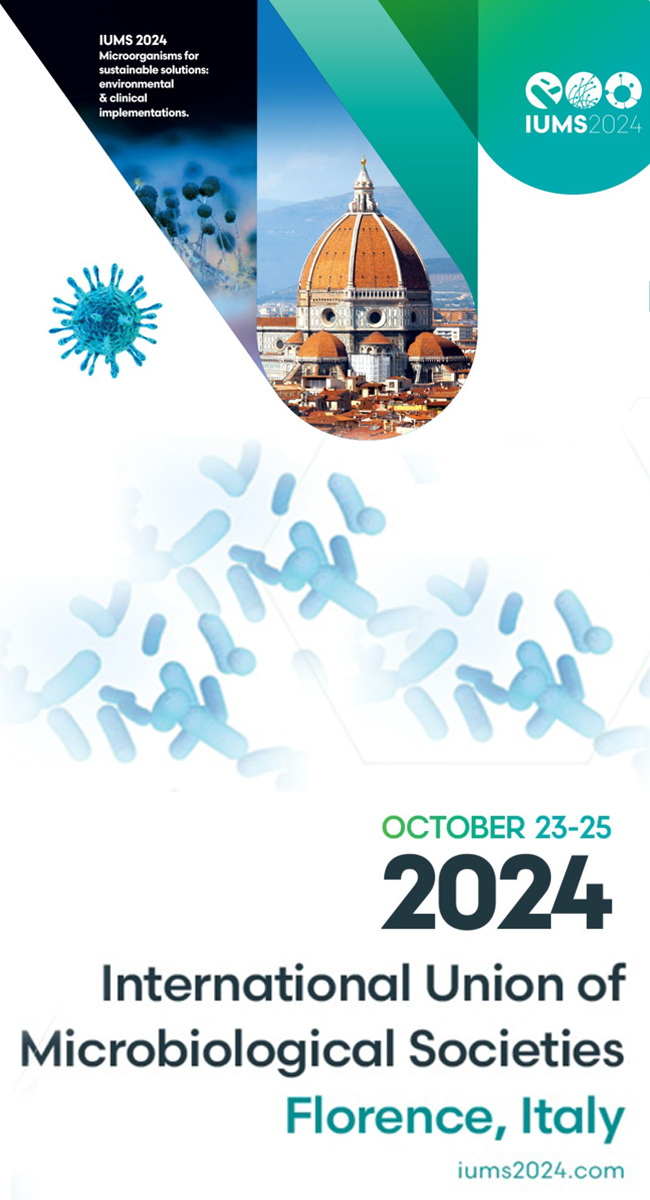


The International Union of Microbiological Societies was founded in 1927 as the International Society for Microbiology. lts first President was Nobel Laureate and Director of the Pasteur Institute in Brussels (Belgium), Jules Bordet. The first International Congress for Microbiology was held in Paris in 1930. At the time of the 10th International Con¬gress of Microbiology held in Mexico in 1970 the Execut...
Read More
President Rino Rappuoli Fondazione Biotecnopolo di Siena EMAIL President-elect Paul R Young School of Chemistry and Molecular Biosciences.The University of Queensland. Brisbane. Queensland. Australia. EMAIL Vice-President Antonio Ventosa Professor of Microbiology Department of Microbiology and Parasitology. Faculty of Pha...
Read More
IUMS consists of three Divisions BACTERIOLOGY & APPLIED MICROBIOLOGY (BAM), MYCOLOGY AND EUKARYOTIC MICROBIOLOGY (MEM) VIROLOGY Within these Divisions are 6 Committees, 9 Commissions and 2 Federations (COMCOFs), under which are subgroups consisting of working groups concerned with bacteriological, mycological and virological research. IUMS acts as an umbrella organization for these scientific researc...
Read More
IUMS Code of Ethics against Misuse of Scientific Knowledge, Research and Resources There has always been the potential for dual application of scientific knowledge for beneficial or malicious purpose. However, current societal and geopolitical changes have increased the risk of the misuse of this knowledge. The IUMS reaffirms its major goal is to promote research and the open exchange of scientific informa...
Read More
IUMS is the International Union of Microbiological Societies, founded in 1927 with the aim to mobilize all microbiological societies globally to promote the development of sustainable solutions to control infectious agents while preserving the global microbial diversity and the healthy life of our planet. IUMS is one of the 31 Scientific Unions of the International Council of Scientific Unions (ICSU). ICSU...
Read More
Affiliation to the Union is in three categories 1. Member Societies (National and International) for a list click here 2. Associate Societies (National and International) for a list click here 3. Supporting Organizations Membership in the first two categories is open to societies or institutions having major interests and activities in microbiology, having a membership of at least 20 microbiologists and h...
Read More